Monday, January 23, 2012

Protecting Girlhood: The Message or the Messenger?

The article, "The House of Dreams," written by Jane Addams describes her concerns for children in regard to how the theater threatens their morality.

Addams argues that children in the labor force are without access to newspapers and moral guidance and as a result, fall prey to the fantasy of the theater. Addams argues that the children viewing these performances and dramas will mimic the often risky and amoral behavior expressed in the dramas.

"Is it not astounding that a city allows thousands of its youth to fill their impressionable minds with these absurdities which certainly will become the foundation for their working moral codes and the data from which they will judge the properties of life?"

Addams conservative views on morals and media reminded me of a radio broadcast I heard last week titled "On Protecting Girlhood" featuring Caitlin Flanagan, author of Girl Land.

http://onpoint.wbur.org/2012/01/18/caitlin-flanagan

Flanagan discusses the dangers children (girls) face with unlimited access to information.

Her concerns are largely centered around culture as expressed through the media of today, the internet and cell phones, specifically the 24/7 access to popular culture's images of girls and women, as well as pornography. This unlimited and easily accessed information often comes without the benefit of real life experience, knowledge, and supervision or accompanied by explanation.

Flanagan's concerns echo Addams' in that both women worry that access to unsupervised information or information without explanation will lead young people astray and at risk of making bad decisions.

Have the internet and cell phones had an effect on adolescence? Is the problem culture or media?

How do you envision the future of adolescence for young people with increasingly accessible media?

Phantom Never Dies


“...Yet these public affairs are in no convincing way his affairs. They are managed at all, at distant centers, from behind the scenes, by unnamed powers….He lives in a world which he cannot see, does not understand and is unable to direct.” (The Phantom Public, 1925)

This description of a “disenchanted man” vividly embodies Lippmann’s sharp and awakening criticism of popular democracy. I was amazed while reading the The Disenchanted Man from The Phantom Public, that even today, about nine decades after these words were published, Lippmann’s skeptical view and argument are still demystifying and enlightening.

In the cold light of experiences he knows that his sovereignty is a fiction” (The Phantom Public, 1925).

To my understating, the “disenchanted man” represents a character of the general electorates/citizens of the country, and Lippmann ruthlessly pointed out that the citizens, as general public, are living under the phantom of the democracy of public opinions. The minority elites and the powerful few behind the stage are the ones who possess ”sovereignty. ” As a foreigner to this country, it is interesting for me to look back and see my path of learning about American politics and democracy. Before I came to the U.S.,I learned all about the greatness of democracy of this country, no matter from classroom, media, or the “anticipatory socialization” process I engaged before I came. I leaned about the electoral system that values everybody’s opinion, the First Amendment that protects freedom, people’s right to unlimited access to knowledge and information, etc. Although superficial, these were the impressions I had about America’s politics and democracy. Then after I lived and studied here for a long time, I gradually realized that the seemingly plausible democracy might not always exist, and the majority public opinions are not always taken into account. However, it was not until I read Lippmann did I find that deep skepticism like this was already spoken out loud eight decades ago.

The actual governing is made up of a multitude of arrangements on specific questions by particular individuals. These rarely become visible to the private citizen” (The Phantom Public, 1925).

Lippmann’s argument predicted what would happen today in terms of the power of public opinions. Power relations and insidious forms of discrimination resulted from power imbalance were the obstacle for the rule of public opinions before, and are still an impediment today, even with the transformation of the mass media landscape and development of new technologies.

I can’t help thinking about my own country while I was reading this. China, as a country with absolute no democracy (at least in my own opinion, and thank God I can say this in this blog without being sanctioned), we never even hold the extravagant hope to worry, or debate about how much weight should be given to public opinions, which is always an absolute “Phantom.”  

stripped of "Truth and Justice"

I really enjoyed W. E. B. De Bois’ article Criteria of Negro Art. I love the irony surrounding the fact that he is a black man writing about the struggles of “Negro artists” in a culture and time period where the predominant thought is that white blood is divine. In discussing the racial inequalities prevalent in the creation of art as a black American, he writes:

We have, to be sure, a few recognized and successful Negro artists; but they are not all those fit to survive or even a good minority. They are but the remnants of that ability and genius among us whom the accidents of education and opportunity have raised on the tidal waves of chance. (Peters and Simonson, pg. 45)

There is more irony in the fact that De Bois is one of the artists he writes about. At the time he was one of those “accidents” prevailing in spite of the white man’s advantage – though he had to do most of his work outside the U.S. In fact, according to his biography in the book, De Bois studied in Germany, was the first African American to receive a Ph.D, and was a major player in the movement for civil rights.

De Bios writes in 1926, some 30 years before the Civil Rights movement:

Suppose the only Negro who survived some centuries hence was the Negro painted by white Americans in the novels and essays they have written. What would people in a hundred years say of black Americans? (Peters and Simonson, pg. 45)


It’s been something like 85 years since he wrote those words. Perhaps it’s time we ask: “What ARE we saying of black Americans today?”

De Bois’ regard for resistance regarding equal rights, even this early in the civil rights game, got me thinking about something that has appeared recently in our modern media – the book “The Help” (well in my case the movie).

DISCLOSURE: I nearly always read a book before watching the movie, but I ended up watching this movie a few weeks ago – without reading the book first (gasp!!). So my comments from here on out are a bit one-sided. However, feel free to comment and correct if, by chance, you have read the book!!

FYI: For those who are unaware, this book is fiction written by a white woman – fairly recently (published in 2009). The author, Kathryn Stockett, writes about a young, educated white woman who boldly writes about black women and their struggles for equality in the South in the early 1960s during the prime of the Civil Rights movement.

This text (OK, movie) strikes me as interesting, and as a great, modern piece to examine, because it is written by a white woman, from the view point of a white woman who realizes the black woman’s struggle to gain a voice during a time when black women were not allowed to have a voice.

De Bois writes:

I should not be surprised if Octavius Roy Cohen had approached the Saturday Evening Post and asked permission to write about a different kind of colored folk than the monstrosities he has created; but if he has, the Post has replied, "No. You are getting paid to write about the kind of colored people you are writing about. …[T]he white public today demands from its artists, literary and pictorial, racial pre-judgment which deliberately distorts Truth and Justice, as far as colored races are concerned, and it will pay for no other. (Peters and Simonson, pg. 46)

It is not surprising to me that a literary/pictorial piece like this exists, and is regarded as legitimate and truthful. Several questions come to mind…

1. I wonder what De Bois would say of the distortion of the “Truth and Justice” when the voice of the black woman is through that of white women?

2. I also wonder how the story might change if a black woman wrote it.

3. De Bois regards all art as propaganda. Again, I’d like to hear his opinion on how this piece may be one that strips and silences one side. (Do you think it does?)

4. Lastly, De Bois says “In all sorts of ways we are hemmed in and our new young artists have got to fight their way to freedom.” (Peters and Simonson, pg. 46) Do you think the young black artists of today are still “hemmed in” and fighting their way to freedom?


Link to info on "The Help": http://en.wikipedia.org/wiki/The_Help

False Communication – Faster Isn't Always Better


In hearing the recent news of Penn State Coach Joe Paterno's death, I couldn't help but be reminded of our recent discussions on communications and the readings for this week. A apologize in advance for bringing up a topic we've heard ad nauseam over the past few months. However, the false early reporting of JoePa's death shows a great downfall of the art of journalistic communication and the written (or tweeted) word.

If you're unfamiliar with the stories surrounding JoePa's death this weekend, or you just want to read the full story, you can check it out here:


This intense oversight and lack of source-checking makes me wonder what Charles Horton Cooley would have to say. Peters and Simonson, in their description of Cooley, say that he believed in "the moral and political superiorities of print over the more "prehistoric" oral tradition." (Peters and Simonson, pg. 21)

First, do you consider digital type in the same category as print? While it is written and distributed to the masses, it can be easily altered at any time. However, digital type is similar to print in that the message is rarely targeted to a specific person, but instead to a large audience.

Many of the essays in the readings for this week tout the great ability for mass media, public opinion and communication to free people from the ideas of those solely in their close vicinity. As Cooley says in his essay, The Process of Social Change, "he is not merely, as in primitive times, a member of a social group which tends to shape his thought and action; he is the point of intersection of many groups..." (Peters and Simonson, pg. 23)

While this particular example about Joe Paterno may be an exaggeration on the norm, it does call into question whether different communication avenues are beneficial, or if mass communication has digressed to an art of fighting to be first, imitating information and acting on gossip. If it has, it is no better than the spoken word. In the JoePa case, the breakdown of information occurred even more quickly than in speech, due to the ability of new technology to instantaneously communicate.

Sunday, January 22, 2012

Text, Lies and the Theater


“After all, what is the function of art but to preserve in permanent and beautiful form those emotions and solaces which cheer life and make it kindlier, more heroic and easier to comprehend; which lift the mind of the worker from the harshness and loneliness of his task, and, by connecting him with what has gone before, free him from a sense of isolation and hardship” (p.29).

Jane Addams’ “The House of Dreams” tackles communication as entertainment—specifically in terms of the theater. Referencing it as a “veritable house of dreams” (p. 26), Addams seemingly chastises the venue for being a fantastical place of escape from the harsh realities of life, and suggests that it gives false hope to younger generations about the certain disappointment that is to result in their futures.
In listing theatre’s contributions, though, Addams’ second characteristic, in my opinion, was notable: that it has the “strange power to forecast life for the youth” by drawing on one’s ancestral past to encourage “valors and vengences” (p.26) and giving man the “thrilling conviction that he may yet be master of his fate” (p.26). This idea can, obviously, only lead to one conclusion.  


Jane Addams, in all her unimaginative glory, would have hated Harry Potter.


…and would have deprived the young adult generation of today the story that so often defines many of us. Harry Potter is everything that she stood so firmly against—teaching children that they are more heroic than humanly possible, that violent duels can always be won, that spells exist at the end of a wooden stick, and most importantly that, at a train station in England, hidden between two platforms, a better and more magical world awaits us. “Is it not astounding that a city allows thousands of its youth to fill their impressionable minds with these absurdities which certainly will become the foundation for their working moral codes and the data from which they will judge the properties of life?” (p. 27).

What Jane Addams would have missed about Harry Potter, and what she misses in the theatre shows she critiques, is the sort unifying communication that is facilitated around them. She says that people go to the theatre “hoping to find a clue to life’s perplexities” (p. 27), but that the only way they can truly find “companionship and solidarity” (p. 28) is by participating in “real” recreation—sports, dancing, etc. She fails to notice the theatrical dialogue that took place among children and the families and friends of her time, which then trickled through the community as a form of shared knowledge. Jane Addams doesn’t see the myriad of people who monitored the launch of last year’s Pottermore.com website, or those who are bonded because they have “liked” Harry Potter on Facebook. She doesn’t see @EmWatson’s 2 million Twitter followers, nor does she track the conversations that fall under the #HarryPotter umbrella.

Yes, some of this is attributed to the progression of media, but I find it interesting that skepticism is what she argues to be a byproduct of the messages communicated by the theatre. Could she have forseen the sellout crowds that met in-person and online for the opening of The Wizarding World of Harry Potter? No. But for being a member of the progressive era, Addams’ suggesting that communication’s only use was for that of concrete, “real” information does produce skepticism—in that she severely underestimated the power of the rapidly evolving state of common ground within the media.   

Influences on Liesure


In June of 2011, the US Department of Labor released a study on how Americans spend their time. The majority of time was spent on personal care/sleep, followed by work and sports and leisure activities.
This isn’t far off Robert S. Lynd and Helen Merrell Lynd’s study, “From Middletown: A Study in Contemporary American Culture. Lynd and Lynd address the rise of consumer culture and the changes on work and leisure by industrialization from 1924-1925.

Lynd and Lynd go on to state that Middletown’s daily routine include making a living, home-making, receiving training in school, or carrying on religious or communal practices (59). The leisure activities that Middletown people are able to enjoy increased by “Saturday half-holidays combined with new possibilities for spending an extra hour to make leisure a more generally expected part of every day rather than an occasional event,” (59).

The post-Industrial Revolution inventions like the automobile, movies, radio engage members of Middletown and allow them to take part in leisure activities in a way they hadn’t experienced before.

Leisure activities and how people engaged with media changed again with the digital revolution. Newspapers, TV, and radio that were cutting edge at one time, are losing ground to social media, Google, online magazines, iTunes, etc.

Lynd and Lynd make the statement, “Middletown has always delighted in talk. The operation of its business as well as many of its professional institutions depends upon talk,” (59). That core statement was true in 1924, and equally true today. The difference of course, is the way that people are sharing information. Instead of attending public lectures, people are tuning into podcasts.

The emerging technologies of the time like radio and movies were a strong influencer of young people. For example, Lynd and Lynd state that, “some high school teachers were convinced the movies were a powerful factor in bringing about the ‘early sophistication’ of the young and relaxing of social taboos,” (67).

What current technologies do you think have the same affect on children and young adults growing up in the U.S. today?

Art is Communication

In The House of Dreams, Jane Addams wrote, "nothing is more touching than his encounter with a group of children and young people who are emerging from a theater with the magic of the play still thick upon them." This beautiful imagery of art is how she begins this essay, that later castigates this very art as causing violence and depravity. Upon further research, I discovered that it was melodrama and vaudeville that cause her concern and she believed that exposure to theater was important in the education of young people. Seven years after Hull House opened, she established a theater where "young people might better understand life through its dramatic portrayal." In February, 1896 she wrote, "There seems to be a general awakening on the matter of plays. We hope this enthusiasm will be utilized to produce plays of good standard. A simple, healthful play with real characters is most delightful, and beneficial to both actors and audience." (Women in American Theater by Helen Krich Chinoy, 2006)

In his book, The Making of American Audiences, Richard Butsch attribues Jane Addams as causing the beginning of censorship stating that Addams was one among many writers who publicized stories of children imitating movie crimes. Censorship then became the result of early reform. Chicago (the city where Hull House is located) became the first city to enact censorship in 1907 followed by dozens of other cities. Reformers claimed censorship improved the moral quality of movies.

Jane Addams understood the power of this art form to communicate a message and she learned how to utilize it to teach and shape young people.

In his essay entitled, Criteria of Negro Art, W.E.B. DuBois discusses art and the racial struggle. First of all, he talks about wanting to be "full-fledged Americans, with all the rights of other American citizens." His conclusion is that until the "art of the black folk compels recognition they will not be rated as human."

The first uniquely American African American art form embraced by the white culture was Jazz. It had it's roots in New Orleans as an "improvisational musical dialogue" from people who didn't have the status or money for formal training. As the white culture allowed this expression of art, it spread to Kansas City, Chicago, and New York where it became featured as the main entertainment in "white-only" clubs such as the famous Harlem Cotton Club. It's rhythmic, hedonistic, rebellious, animalistic nature became synonymous with decadence, base morality, and pleasure-seeking of the time period. The musical Chicago, portrays Jazz and booze as the cause of every evil from promiscuity to murder.

The white people of the time didn't take the black community seriously, but had no trouble using their music for their own pleasure and purposes. The Cotton Club, for example was an elite, white only jazz club set in Harlem. That in itself is an ironic twist of the times because they needed a place to dance and hear their favorite music, but it was only available from black musicians. (source, Dr. Clark Roush, Ph.D. in Music Education)

I've attached a video showing a scene from the movie musical Hello Dolly. This is not a jazz club, but it is an example of "black people in their place" which was to entertain only. Notice the band in relationship to everyone else in the scene. http://www.youtube.com/watch?v=4ulSJRtGSgI
Louis Armstrong is a kingpin of Dixieland Jazz, but in this scene is portrayed as a caricature.

W.E.B. DuBois understood the power of art to communicate a message. In fact he believed art to be propaganda, stating, "I do not care a damn for any art that is not used for propaganda. But I do care when propaganda is confined to one side while the other is stripped and silent."

My questions is this, is DuBois' propaganda, communication?

Theatre and Social Change

Jane Addams argued in The Spirit of Youth and the City Streets (1909) that theatre, however essential to society, has the ability to corrupt children by setting the wrong example of how people solve real world problems.  Young people are often ignorant of the processes that go into life as they have not yet had the required experiences that allow them to mature into adults.  Therefore they make decisions based not on right or wrong but on what is "exciting and appealing to his outward sense, of in his ignorance and foolishness blundering into substances which are filthy and poisonous" (Addams, p. 27)  Addams' argument is based on what she has seen in her work at Hull House.  She views theater as becoming the moral compus of young people.  The "make-believe" in theater does not translate as "make-believe" to a child.  Once they see how their favorite heroes act on stage they may translate those actions into daily life.
"'Theater is literally making the minds of our urban populations today. It is a huge factory of sentiment of character, of points  of honor, of conceptions of conduct, of everything that finally determines the destiny of a nation.  The theater is not only a place of amusement, it is a place of culture, a place where people learn how to think, act and feel.' Seldom, however, do we associate the theater with our plans for civic righteousness, although it has become som important a factor in city life." (Addams, pg. 28)
Addams proposes more public interaction through leagues, social groups and recreational activities in public spaces.  Rather than have kids watch and learn social norms through the mass medium of the day, theater, she thinks they should be out socializing among people their own age in real environments in the urban setting.

While I believe in public space should be available to provide for social groups to come together, theater is a useful tool in harnessing social change and acceptance. Below is a video from TED Talks talking about how theater can be a tool for social change:

This YoutTube clip is from TEDx-Adelaide.  TED Talks is a forum that hosts events around the world to discuss ideas that have the ability to impact and change the world.  The topics range widely and speakers from all walks of life are encouraged to sign up and participate.  Edwin Kemp Attrill is a freelance theater artist, producer and artistic director of ActNow Theater for Social Change.  He was worked as a director and tutor for Urban Myth Theater of Youth, No Strings Attached Theater of Disability, Vitalstatistix and in youth detention centers across SA.   In the video he discusses how we can use theater as a tool to change social behavior.  He argues that it can be used for good and establish acceptance for different view points and beliefs.

Addams seems to be short sited on the good ideas that can be propagated through theater.  Children can find acceptance through normalization of quirky characters.  They can be taught tolerance and acceptance for different ideas and beliefs.  Understanding that this is obviously not the theater that Addams is discussing in the selection, she does not advocate for the ideas that theater might be able to teach kids.  Theater was and is a way to spread ideas through popular culture.  It creates a forum for topics that might be taboo in society to discuss to be discussed in a semi-public forum.  

I argue that theater is good for young people.  Opening young minds to new ideas rather than allowing them to normalize public opinion through socialized organizations leads to maintained social order.  The theater can be a reflection of the weaknesses in society.  It can open up discussion and provide alternative views points that may not be heard through natural society. Without the theater's creative expression, we limit the progressive ideas that make the world a better place.

Social Media & Social Change: Cooley's Marriage of Concepts


PHOTO: Reuters/John Kehe Illustration

Charles Horton Cooley writes in his essay, “The Process of Social Change” about writing and printing (read: mass media) on social change.  He writes that “[p]rinting… does open a path along the margin and give every one a cup from which to drink” (Peters & Simonson 2004, 22).  He presents that because printing makes writing available to a larger audience, that then that larger audience can reap the benefits of being informed.  He points out that one of these benefits is the recognition of a social relationship to the whole social group (22-23) – that social communication is “the precise measure of  the possibility of social organization” (22).  Another benefit that he notes is that the availability of information from mass media increases the feeling of freedom of the individual and individual development, or originality (23).  He argues that this freer development or originality allows for more development of social order (24).  My favorite quote in this article is when he argues that mass media allows for greater social change because of the availability of information:

Modern society… is more like the uninterrupted ocean, upon which the waves of change met with no obstacles except one another, and roll as high and as far as the propagating impulse can carry them (24).

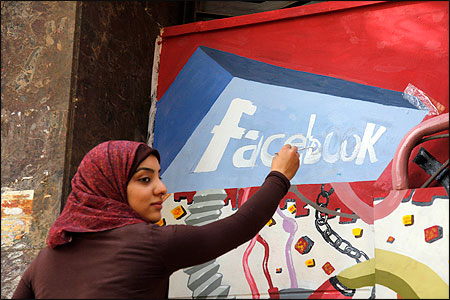
Photo by Manoocher Deghati/The Associated Press
Cooley's essay could be applied precisely to the role that social media plays on social change today.  In particular, I was thinking about the direct correlation between social media and the Arab Spring.  This article in the Huffington Post summarizes the importance of recognizing the role that media plays on social change – even platforms like Facebook, and Twitter.


Raymond Schillinger writes:

Alec Ross, the tech paragon of the State Department, who has spent the past few years merging cutting edge technology with the mission of diplomacy … equated the rise of social media to a democratization of world politics, shifting the balance of power from nation-states to individuals and smaller institutions… (Schillinger 2011).

I would argue that social media and social change are tied to each other today -- and  Cooley would agree.  What do you think?

Communication, Propaganda, and Consumerism

"The fields in which public opinion can be manipulated to conform to a desired result are as varied as life itself" (Bernays, pg. 55).

I used this quote to open my blog post because I felt it sums up many of the readings in the first section of the book. Bernays's article in particular stood out to me because he addressed how easily mass communication and propaganda can influence public opinion - from the major, "It is one of the manifestations of democracy that anyone may try to convince others and to assume leadership on behalf of his own thesis" (p. 51) - to the mundane, "Public opinion may be marshaled for or against even salad dressings" (p. 56). Bernays uses the example of fashion trends to display the tight grip that communication and social thought can hold over the way we dress and spend our money. Much as it was for velvet and American-made silk back then, masterful propaganda campaigns still hold much sway over the choice we make in fashion, and even sadly, the lengths we go through to make our bodies match a certain ideal.

Lasswell wrote on the power of propaganda, "...The fact remains that propaganda is one of the most powerful instrumentalities in the modern world. It has arisen to it's present eminence in response to a complex of changed circumstances which have altered the nature of society" (p. 49). Altering the nature of society? Wow, that's kind of a big deal! Going back to my comment about trying to make our physical selves match a certain ideal - look at how society's perception of beauty has transformed, and how the circulation of mass media which has in turn manipulated public opinion has caused society to change it's idea of what human beauty is.

Jane Addams addressed the negative influence that media can hold over children when she discussed the power that the theater holds in influencing young boys. "It is as if a child, starved at home, should be forced to go out and search for food, selecting, quite naturally, not that which is nourishing but that which is exciting and appealing to his outward sense, often in his ignorance and foolishness blundering into substances which are filthy and poisonous" (p. 27). One current example of this that I can think of (that also equates to the shifting ideal of beauty) is the "Jersey Shore" TV show, which glamorizes a certain type of lifestyle and physical appearance is has become wildly popular due to impressionable youth. The apathetic attitude of many adults towards allowing the influence of propaganda and mass media on their own children also contributes to shifts in social norms.

In Lynd and Lynd's "Middletown," they capture the propensity of many adults to allow social media to teach their children. "One working class mother frankly welcomes the movies as an aid in child rearing, saying, 'I send my daughter because a girl has to learn the ways of the world somehow and the movies are a good safe way'" (p. 67). While mainstream movies back then were likely much more educational then they are today (as entertainment seems to be the chief concern of today's filmmakers), the tendency to save time and grief on parenting by parking kids in front of the TV screen is still alive and well.

When enough people agree that something is "good" or "the way it ought to be" it becomes and idealized phenomena, brought about by public opinion. "...Public opinion represents the thought of any given group of society at any given time toward a given object. Looked at from the broadest standpoint, it is the power of the group to sway the larger public in its attitude towards ideas" (Bernays, p. 52). Going back to the salad dressing comment, and the power that public opinion holds over our own consumerist tendencies, I find it fascinating how food manufacturing companies use popular media to control even the choices that we make when eating food.

One is example is the debate over high fructose corn syrup. It is present in a plethora of foods in the U.S. namely because it is a much more cost effective way to sweeten food. People never gave much thought to it until research emerged showing that it could be unhealthy. This CBS news report characterizes this battle of public opinion: http://www.cbsnews.com/stories/2010/03/10/eveningnews/main6286934.shtml
Even in this CBS article, the author stated, "So companies are busy removing high-fructose corn syrup from some products, citing reasons like "consumer trends." There was enough of an outcry in public opinion over the validity of HFCS as a safe food additive that manufacturers were forced to take it out. Suffering from a loss of profit over this new public opinion, the Corn Refiners Association launched a media campaign  to counteract any negative feelings towards HFCS by making the consumer feel it is safe through the use of imagery of happy, healthy families serving products with HFCS to their families and walking through picturesque corn fields: http://www.sweetsurprise.com/news-and-press/advertising

Saturday, January 21, 2012

Will media effects last long in Chinese society ?


“The general opinion of large numbers of persons are almost certain to be a vague and confusing medley, action cannot be taken until these opinions have been factored down, canalized, compressed and made uniform.”

Chinese people are more conscious about the life they are living for today than before. On various media, you can find complaints and critics of food safety, environmental problems, ridiculously high price of real state and overwhelming survival costs, etc. That’s not only because these problems are far more rampant now, but also because Chinese people find out what kind of life people in other countries have from Internet or other media.  As more people start using microblog – Chinese version of Tweeter – this kind of voice can be heard clearer and louder. Especially the famous people or celebrities play an indisputable act in this social interaction process. Once one of them posts a short blog on its microblog, his/her thousands, even millions of followers will transfer and repost it again. Then this voice can be extracted or copied by newspapers, and other social media, which will almost reach every single Chinese audience at the time. This time, Chinese government has to take action with it. Of course, sometimes government can still cover something.

But the problem here is these topics and social problems can only attract people’s attention for a short time and soon they will be something else replaced and forgotten by people. So how would media contribute to the long-term improvement of society and people’s life instead of only being a tool of searching and distributing information?


Democracy in America?!

"As Lippmann and many others noted, high hopes about the political role of the free press go back to the founding era of the United States and to the Enlightenment."

Really? Well, I suppose we could begin by problematizing phrases like "free press" and "high hopes" to better understand how this relates to our current networked media. There seems to be an unspoken, at other times clearly indicated, classification for what we take to be "serious" news versus mere farce or caustic satire. Depending on the demographic, one will take the satire as serious, and the other the serious as straight faced farce, i.e. a joke.

In this current election, it has been noted that Newt Gingrich will not do well with women voters. Given the nature of the 'scandal' (I use the term loosely here), and since we have so many women in our class, I'm curious.

I'm relating this post to the overarching sentiment that I began this post with. It is a popular and fashionable idea in the history of communication and media, i.e. the faith and hope that we humanity have placed upon the potential of our communication to bring about democracy and dialogue.

So... Does this sort of media have anything to contribute to democracy? If so, how and what? If not, why?

The Daily Show With Jon StewartMon - Thurs 11p / 10c
Indecision 2012 - The Freaker of the Spouse - Newt Gingrich's Negotiation Skills
www.thedailyshow.com
Daily Show Full EpisodesPolitical Humor & Satire BlogThe Daily Show on Facebook

Class in America?

Class divides. Class divides? Class divides! Which is it?

It seems that some of our political leaders believe that "class" is an issue of importance for the American people. Other don't agree. Does "class" divide as presidential hopeful Rick Santorum indicated in a recent debate? Or, consider, as Mr. Santorum references, President Barrack Obama's notion of "class warfare." Is the issue of "class" one of importance? Does "class" matter or even exist in the day to day of today? What do you think? Don't hold back.

Monday, April 11, 2011

Cultural groundings, networked society, locational specificity...and bears, oh my!

One of the conclusions that Castells's claims is that culture is defined by networks. He argues that, "infinite social distance is crated between this meta-network and most individuals, activities, and locales around the world. Not that people, locales, or activities disappear. But their structural meaning does, subsumed in the unseen logic of the meta-network where value is produced, cultural codes created, and power is decided" (p. 508). The implication of this has me reeling and left with a ton of questions. How would one delineate different cultural groups in such a society? Would the groups be organized around interest? If so, what would happen when a given social interest ceased to exist? Say, for example, that there was a culture that developed around the "Tarzanian" peace movement. The culture existed in the interactions of those involved by their personal interest and "connectivity" to the nodes of discussion and action for the Tarzanian peace movement. What would happen if peace fell over Tarzania and the need for such a culture disappeared?

I could wrap my head around this idea a lot easier until the extension of this line of argument comes into existence saying, "because of the convergence of historical evolution and technological change we have entered a purely cultural pattern of social interaction and social organization. This is why information is the key ingredient of our social organization and why flows of messages and images between networks constitute the basic thread of our social structure" (p. 508). Here the claim seems to be that social interaction and organization are the only thing that produces culture within a networked society. Not only is that a huge claim, but one that seems to have gaping chasms in between the logic. I find it hard to imagine a world in which people are not somehow socialized based on their locality. People learn from their parents and the people who surround them early in life, during the formative years, before the interact with the potential for networks that go beyond location. In that way, some of people's culture is still grounded in where they come from and grow up. I can imagine that later in life, they can be greatly influenced by the networked society that Castells points out, but to claim that information is the key ingredient to social structure feels a bit overstated. We are not ready to jack into the matrix and let our cultures be wholly consumed by information flow. I agree with a slightly less drastic claim, that we are moving toward a truly networked society in which information flow allows new cultural norms to be learned and practiced, but I do not agree that this transition has either occurred yet or subsumes traditional senses of location and development. Still, the many questions that I spawned above show the heuristic value in the claims being advanced. Fun stuff.

Too Much Information?

Social critic Neil Postman contrasts the worlds of George Orwell's Nineteen Eighty-Four and Aldous Huxley's Brave New World in the foreword of his 1985 book Amusing Ourselves to Death. He writes:

What Orwell feared were those who would ban books. What Huxley feared was that there would be no reason to ban a book, for there would be no one who wanted to read one. Orwell feared those who would deprive us of information. Huxley feared those who would give us so much that we would be reduced to passivity and egoism. Orwell feared that the truth would be concealed from us. Huxley feared the truth would be drowned in a sea of irrelevance. Orwell feared we would become a captive culture. Huxley feared we would become a trivial culture, preoccupied with some equivalent of the feelies, the orgy porgy, and the centrifugal bumblepuppy (An advanced, consumerist form of tetherball played by the children in Aldous Huxley's novel).

As Huxley remarked in Brave New World Revisited, the civil libertarians and rationalists who are ever on the alert to oppose tyranny "failed to take into account man's almost infinite appetite for distractions." In 1984, Orwell added, people are controlled by inflicting pain. In Brave New World, they are controlled by inflicting pleasure. In short, Orwell feared that what we fear will ruin us. Huxley feared that our desire will ruin us.

In our class discussion we have mentioned the increasing amount of information available for us to "consume." Does the Networked society bring us closer to Huxley's fear that we would have so much information as to be reduced to passivity and irrelevance, or does it walk the fine line between these two contrasting, futuristic outlooks?

Post-Modernity and the Networked Society

In the 2nd half of our Castells reading there was a ton of material that was presented.  Castells brings up the concept of real virtuality which he defines as "a system in which reality itself (people’s material/symbolic existence) is entirely captured, fully immersed in a virtual image setting, in the world of make believe, in which appearances are not just on the screen though which experience is communicated, but they become the experience" (404).  This concept, in addition to the ideas of space of flows and timeless time, makes for  a number of questions.

I guess my question for class dips into my book review's concepts.  Streeter argues that "technologies are socially constructed" meaning that technology (including the networked society) are the direct result of deeply embedded social processes.  While one cannot argue with Castells's well supported contention that our networked society is shaped by the space of flows and the resulting in timeless time (495), how would Castells respond to the claim that the networked society is simply a result of our society and culture reacting to post-modernity?  Castells argues that "the emergence of a new electronic communication system is characterized by its global reach...[and] through this new communication system, mediated by social interests, governmental policies, and business strategies, a new culture is emerging: the culture of real virtuality.  (358)

Essentially, it is possible that the networked society has, and will have no, discernible effect on humanity; but rather that this "real virtuality" already existed and how we have chosen to utilize this new electronic communication has created the support, and effect, of which Castells speaks?

Monday, April 4, 2011

Cutting Down to Size...

Literally.  With the current technological advancements in image/video editing, advertisers are finding more extreme ways to "cut women down to size." As a result, unrealistic images of women with unattainable characteristics are surfacing in mass medium channels across the globe. Our society's fascination with beauty is transferred from a flawless doll (Barbie) to the pages of fashion magazines.  Society's expectations physical beauty become even more apparent as young girls develop into young women. Our world is surrounded by the thought of image and unfortunately the media often play a large hand in pushing these unrealistic ideals into society's expectations of women.


The following ads were released by designer Ralph Lauren.  The images were quickly pulled from the media after mass outrage over the models' incredible distorted bodies. The model in the top photo, Fillipa Hamilton, claimed she was fired shortly after the ad ran for being too fat (she was a size 4).  See Video: http://today.msnbc.msn.com/id/33307721/


I thought you might also find the following interesting:


Question for class discussion

With the new economy being information based as opposed to production based, do you think that this will widen or lessen the chasm between the haves (the Western world) and the have-nots (everyone else)?